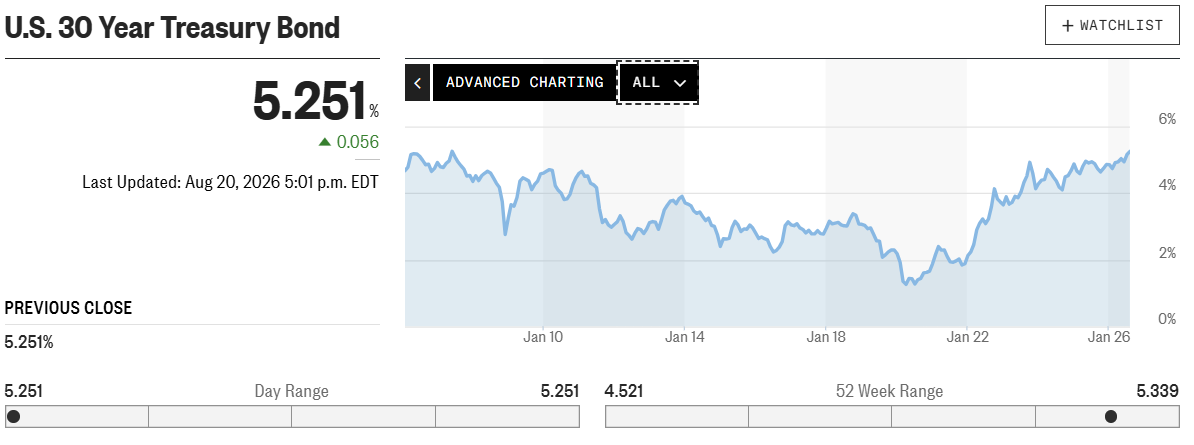
Not QE II
Today, the US Treasury announced that they would be doubling the amount of treasury buybacks- meaning they are doubling the amount of treasury debt that they will buy back at par because they are getting so many people (Japan) wanting to sell treasuries, “as evidenced by the significant volume of high-quality offers Treasury routinely receives in longer-dated buyback operations.”
The Treasury announced,[1]
“WASHINGTON, D.C. —The U.S. Department of the Treasury is increasing, by at least double, the size of liquidity support buyback operations for longer-dated nominal coupon securities (the 10-year to 20-year sector and the 20-year to 30-year sector). The current maximum size of $2 billion per operation will be at least $4 billion per operation.
This change is effective September 9, 2026 and will be in effect for the remainder of this refunding quarter (through November 4, 2026). Treasury will provide more information about future buyback sizes at the next Quarterly Refunding, scheduled for November 4, 2026.
This increase in buyback operation sizes reflects Treasury’s desire to provide greater liquidity support in longer-dated nominal sectors where there is consistent strong sponsorship from market participants, as evidenced by the significant volume of high-quality offers Treasury routinely receives in longer-dated buyback operations.”
Basically, Treasury Secretary Scott Bessent is afraid that the Japanese and other investors will sell Treasury debt because they need dollars to buy imports (oil) because everything is getting expensive as the Federal Reserve (Fed) prints dollars to buy treasuries to fund the American government (see chart below). That could result in there not being enough buyers in the open market to keep the price of treasuries from tanking while raising interest rates.[2]
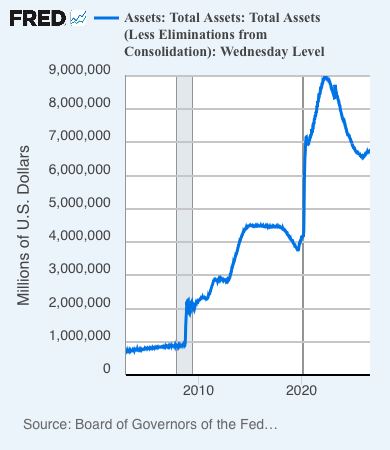
As seen above, the Fed owned fewer than $4 trillion of assets in September 2019 and then printed enough money to own $7 trillion in assets today (stocks and bonds)- down from $9 trillion in 2022.
For example, if the Treasury were selling $100 of new US debt for 10 years at 4.7% interest while Japan were willing to sell similarly dated treasuries at a discount, a buyer may choose to pay $95 or $85 for the $100 worth of treasuries resold by Japan instead, resulting in the US Treasury needing to either raise interest rates to attract borrowers or for the Fed to print even more money to finance social security. To keep higher interest rates or hyperinflation from tanking the US economy (housing), the Treasury is offering to buy the treasuries held by Japan instead.
Ideally, the Treasury will be using money already in the Treasury to buy back the debt that they are simultaneously selling, but the United States Bureau of Engraving and Printing in the Treasury Department prints the physical Federal Reserve notes- commonly called dollars-the cash in your wallet.[3]
So, the Treasury could also be printing physical cash to buy back the debt without most people knowing, because that knowledge would cause investors to sell treasuries instead of buying them. Secretary Bessent can plausibly say that this is not QE.
QE- quantitative easing- is jargon for printing money. When the Federal Reserve initially started printing money again in September 2019 in response to interest rates rising in the Repo Rate Crisis that led to the covid lockdowns, Chairman Jerome Powell said that, “This is not QE. In no sense is this QE.”[4]
The alternative to QE and “Not QE” is to stop going into debt. Using 2025’s numbers, that would require an immediate spending cut of at least $1.78 trillion to account for the deficit to get down to the $5.23 trillion Americans paid in taxes-minus $1 trillion to pay the interest on the debt- leaving $4.23 trillion to pay for fiscal year 2026’s $4.35 trillion cost for Medicare, social security, the military, and nothing else. No science grants. No Fannie Mae or Freddie Mac to provide cheap housing loans. No VA. No Post Office. This scenario assumes that a recession doesn’t result in fewer taxes being collected.[5][6]
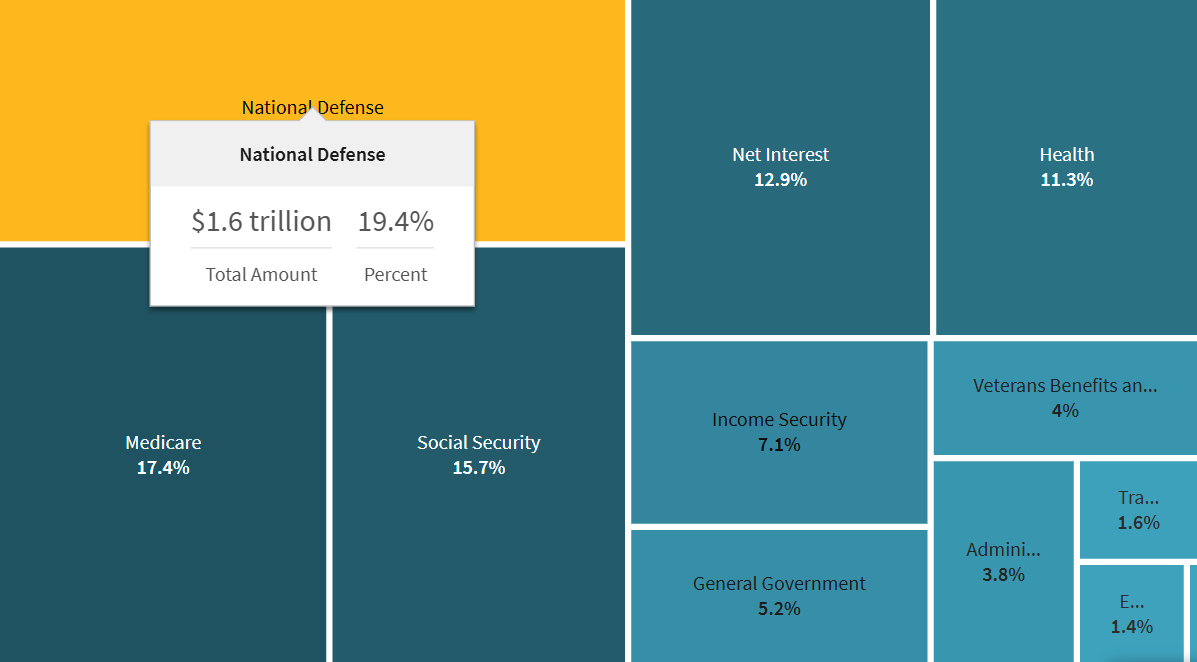
Source: usaspending.gov
No politician will vote to cut grandma’s social security payments, and they’ll scape-goat the Federal Reserve and Treasury if they don’t finance it all, so Scott Bessent is doubling the size of treasury buybacks to kick the can down the road.
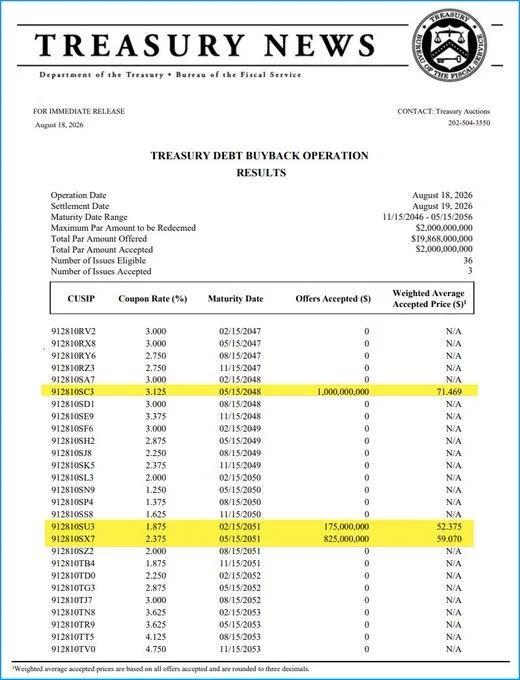
Editor’s Note August 20, 2026: Secretary Bessent went on CNBC and said that they could buyback even more than the double number of treasuries that they had already promised. Additionally, Dr. Chris Martenson pointed out on twitter that the Treasury bought the treasuries back between 52 and 71 cents on the dollar today.[7]
[1]https://home.treasury.gov/news/press-releases/sb0607
[2]https://www.ft.com/content/0f9b2fe7-bde4-4f5f-b49e-93ccb5da9ea8?syn-25a6b1a6=1
[3]https://www.bep.gov/currency/how-money-is-made
[4]https://www.hamiltonmobley.com/blog/not-qe
[5]https://fiscaldata.treasury.gov/americas-finance-guide/government-revenue/
[6]https://www.usaspending.gov/explorer/budget_function
[7]https://x.com/chrismartenson/status/2090512084647768512