I Am the House Now
As announced on August 25, 2026 by US Treasury Secretary Scott Bessent, today is Economic D-Day. While initially planning on buying twice the $2 billion in long-dated treasury buy-backs, the Treasury announced that they would buy back $6 billion tomorrow. The point being to lower interest rates.[1]
Per Sarah Holzmann writing at Bar Chart,[2]
“The market reaction was decisively negative for bonds. The benchmark 10-year Treasury yield ($TNX) surged to approximately 4.85%, its highest level since November 2023, while the 30-year yield climbed back toward 5.30%, approaching the 19-year high of 5.34% reached last month.”
That didn’t work.
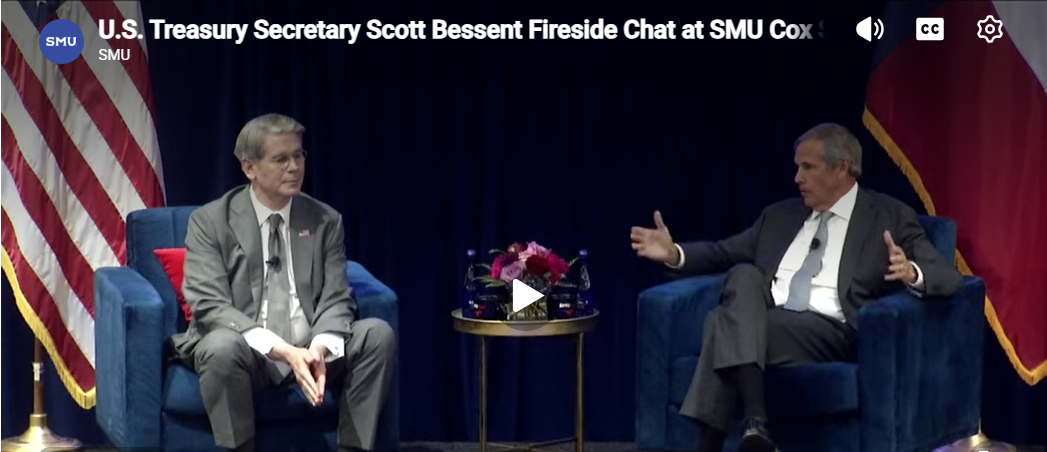
It seems that the market may be reacting in part to his inflammatory statements from yesterday, when being interviewed by Ray Washburne at the Cox College School of Business at Southern Methodist University in Dallas.
19:47: Bessent: During August it was the sky is falling. The US is not going to be able to pay its debt. It was absurd, but it just became kind of the dominant narrative. Let’s just slow this down. The US bond market has been the best performing bond market in the world since President Trump came in. If people were worried about the US bond market- or the US defaulting- that they would be selling US bonds and buying German bonds or Japanese bonds, but the US bonds were performing better.
I don’t really care what rating agencies say, but three weeks ago- because it wasn’t a kinda gotcha headline- the press didn’t report Fitch reaffirmed the US ratings. That our debt to deficit GDP would have been down year-over-year, except the Supreme Court made me give back 180 billion dollars of tariff refunds.
So, we actually were having a fiscal consolidation. So, to the extent that when I was in private business, I tried to be fact based, now I try to slow things down. Get people to get out of their fever dream and look at the facts.
Washburne: Well, I would guess during- when you guys shorted the British pound- which was one of the great trades of all time- that was pretty fast. Was that a pretty fast happening deal? Or was it a slow trend type?
Bessent: It’s an overused phrase, but the Ernest Hemingway, “How did you go bankrupt? Slowly and then quickly.” So, it was one of those- we had been working on it for a long time, and then when it happened, it went quickly. It was the same with the Japanese yen. Shorting that and thinking about it.
The other thing too is that, just because, again, the press, people on the other side wanna play gotcha, this time last year, we used what’s called the Exchange Stabilization Fund, and we bridged Argentina during the Argentinian elections. So, your question was, “You’re doing these interventions, why are you doing them?” And I believe that I can use the balance sheet of the US for foreign policy. So, we have a foreign policy goal and that is to create allies in the Western Hemisphere.
Argentina was the frontrunner for that, and it was my belief that the Milei government had sound policies. The opposition was using their capital market to try to create panic and cause a currency crisis. If I could step in, bridge them through the election- makes money for the US government- then they got to the other side of it. And president Milei won- President Trump endorsed him. Capital markets were good. And President Milei won- beat expectations. And they’re off to the races.
But more importantly, with the Argentine election that was followed by Chile went from crazy left-wing government back to a center-right government. Columbia has now gone from you know a hardcore Marxist government back to a market-based government. Ecuador. Bolivia. So, all these countries are following same thing. Whenever people say, “Oh, well Treasury Secretary is taking a risk,” I say, “Well, it’s my dream. I have asymmetric information. I am the house now.”
So, when we intervene with the Japanese yen, I have pretty good insight into what the Bank of Japan’s gonna do, what Japanese policy makers are going to do. You can bet against me if you want.
For context, Bessent made his bones working for George Soros when they broke the Bank of England by betting against the British pound in 1992. Now, he is working against people shorting the US dollar and the Japanese yen (so that the Japanese don’t sell US treasuries to strengthen the yen, raising US interest rates).[3]
When suggesting that if people really feared a US debt default, then they would be fleeing to safe haven assets like German or Japanese government bonds, he noticeably doesn’t include gold because gold already replaced treasuries as the largest asset owned by central banks in 2025.[4]
Considering that rising interest rates is the end of the Greenspan Put, it might be a good idea to listen to Greenspan’s opinion on the dollar.
“Gold is a currency. It is still by all evidences the premier currency where no fiat currency, including the dollar, can match it.” -Federal Reserve Chairman Alan Greenspan (1987-2006), in an interview for the Council on Foreign Relations, Nov 2014.
End Note: Bessent was stammering and stuttering the whole time. The author cleaned up the transcription.
[1]https://www.hamiltonmobley.com/blog/economic-d-day
[3]https://kellywohlner.hightoweradvisors.com/blogs/insights/soros-bessent-and-the-pound
[4]https://www.federalreserve.gov/econres/notes/feds-notes/why-gold-didnt-actually-overtake-treasury-securities-as-the-worlds-favorite-reserve-asset-20260903.html “In 2025, world international reserves held in gold surpassed foreign official holdings of U.S. Treasury securities (figure 1), a fact drawing attention from media and policymakers (Nangle, 2025; European Central Bank, 2026; Storbeck and Hook, 2026, for example).”
Federal Reserve economist, Colin Weiss, wrote source 4 and argues thatthis shouldn’t be interpreted as gold overtaking U.S. Treasury securities in its appeal as a reserve asset because the rise in the market value of gold reserves since 2024 was primarily driven by a surge in gold prices… That is the entire point!