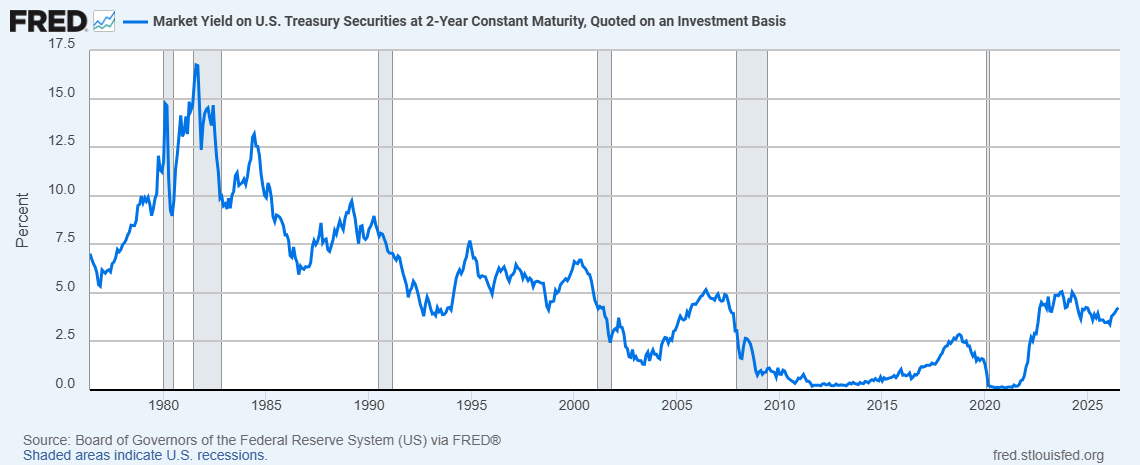
2-Year Treasury Yield
“I think we are actually at a point of encouraging risk-taking, and that should give us pause. Investors really do understand now that we will be there to prevent serious losses. It is not that it is easy for them to make money but that they have every incentive to take more risk, and they are doing so. Meanwhile, we look like we are blowing a fixed-income duration bubble right across the credit spectrum that will result in big losses when rates come up down the road. You can almost say that that is our strategy.” -Jerome Powell, Chairman of the Federal Reserve, then member of the Board of Governors, Oct 2012 Federal Open Market Committee Meeting.
Since 1987, the Federal Reserve (Fed) has been juicing the economy and financing the expansion of government by progressively lowering interest rates- a policy called the Greenspan Put. The Fed does this by lowering the Federal Funds Rate, which lowers interest rates yielded by US treasuries.[1]
In regard to the above quotes, the yield on 10-year treasuries has risen in response to every Federal Funds rate cut since September 2024.[2][3]
The yield on 2-Year treasuries has been noticeably rising since we started bombing Iran again on Feb 28. Its yield had been trading in a decreasing wedge pattern since 2022, while that decreasing wedge pattern has been rising from a decreasing wedge pattern that started in the 1980’s- meaning potential breakout. Treasury yields are the “fixed income duration rates” of which former Fed Chairman Powell spoke of losing control.
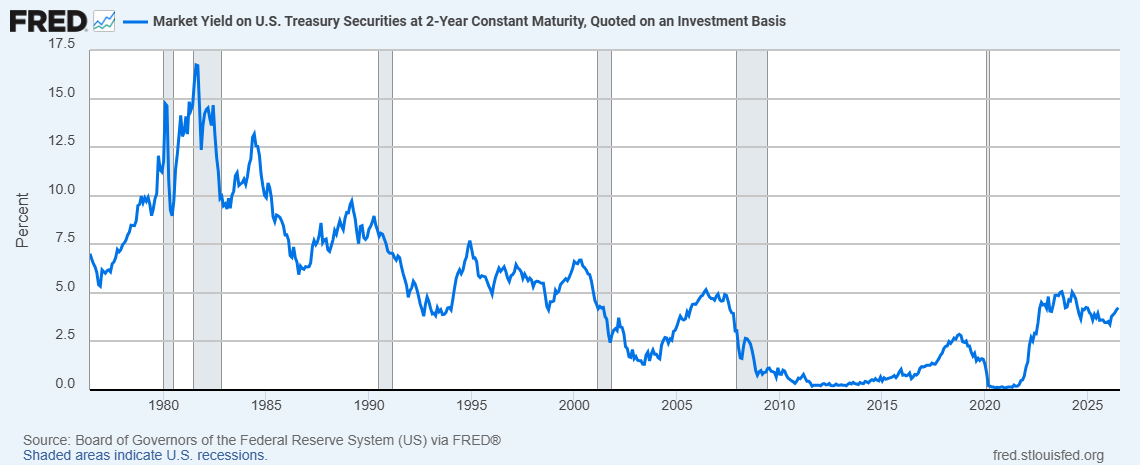
If the Fed is losing control of long-term and now short-term interest rates, that means that many businesses and investments that have been relying on low-interest rate loans for the past 15+ years may go out of business or lose money. It will cause a domino effect, “right across the credit spectrum,” as fewer people/businesses qualify for loans and have to sell their assets. The housing market is at historic highs while interest rates are near historic lows.
The first near breakout of interest rates- after the Fed initially cut interest rates in response to the 2008 Great Recession- started in December 2015 and ended with the repo crisis of September 2019, leading to the release of covid so that instead of being blamed for the resulting inflation and job loss starting in 2020, the government could be the solution (vaccine) to the problem- all we had to do was obey. Hence, Fauci needed a presidential pardon and was pleading the fifth on Wednesday in front of the Senate Homeland Security and Governmental Affairs Committee, chaired by Sen. Rand Paul.[4][5][6]
So, to say that the government might be willing to go to extreme lengths to keep interest rates low would be an understatement. Currently, Treasury Secretary Bessent and the Fed are uniting with the Bank of Japan (BOJ) to keep the Japanese yen from devaluing, because as the yen becomes worth less in response to the BOJ printing yen, the BOJ has been selling US treasuries, which results in higher treasury yields!*
Per the Financial Times,[7]
“The US Treasury intervened in yen exchange rates on Friday, marking the first time Tokyo and Washington joined forces to support the Japanese currency via outright purchases in nearly 30 years. The Federal Reserve Bank of New York undertook the unusual move of conducting a sale of euros to buy yen on behalf of the Treasury, according to three people familiar with the matter.”
A weakened Euro won’t do well for the Europoors even as it makes European products cheaper for the Japanese.
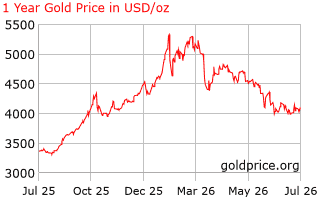
Rising interest rates also mean that gold could soon rise as investors looks for an alternative to treasuries- the safe haven asset of the past half century- because higher interest rates mean either hyperinflation or debt default for the USA. Interestingly, gold prices appear to be at the end of a decreasing wedge pattern that started in January.
*End Note: The BOJ sells treasuries in exchange for dollars, and then uses the dollars to buy yen in the currency markets to make the yen more valuable. Basically, someone with dollars who wants yen wants to get as many yen as possible, say 164 yen for one dollar, but the BOJ is willing to get fewer yen, say 159, so that price gets averaged into the day’s trading and the yen is worth more on the international market that is priced in dollars (Japanese people with yen would rather spend 159 to buy rice than 164, if rice costs 1 dollar).
The US Treasury wants to sell treasuries to pay for the war with Iran and welfare, so if the BOJ- our largest foreign investor- is selling US treasuries instead of buying them, that means that the Treasury has to raise interest rates to attract lenders, or the Fed has to act as the lender of last resort by printing money to buy treasuries to finance the government. See the first source for an explanation.
[1]https://www.hamiltonmobley.com/blog/printing-money-lowers-interest-rates The actual way that the Fed lowers the Federal Funds rate and US treasury rates.
[2]https://fred.stlouisfed.org/series/EFFR
[3]https://www.marketwatch.com/investing/bond/tmubmusd10y
[4]https://www.hamiltonmobley.com/blog/risky-debt This was written by the author in September 2019, as the repo crisis was starting.
[5]https://www.judicialwatch.org/coronavirus-mutants/ Covid was created by gain of function funding authorized by Fauci.
[6]https://www.youtube.com/watch?v=1IUD5tBd6Yw Senate hearing.
[7]https://www.ft.com/content/0f9b2fe7-bde4-4f5f-b49e-93ccb5da9ea8